Thursday, February 15, 2007

Chrysler Workers Express Fear, Optimism

Associated Press | By RANDALL CHASE 02.14.07, 4:13 PM ET - - DaimlerChrysler employees were hit Wednesday with news of impending layoffs as a result of shift eliminations and plant idlings under the company's restructuring plan, but some remained hopeful that they will find a way to keep working.

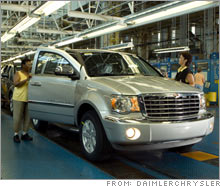
The Newark Assembly Plant, which makes the slow-selling Dodge Durango and Chrysler Aspen mid-sized sport utility vehicles, is scheduled to go from two weekly rotating shifts to one shift in the second quarter of this year. DaimlerChrysler (nyse: DCX - news - people ) plans to idle the plant, which employs about 2,100 workers, in late 2009 at the end of the Durango's production run.

Overall, some 13,000 Chrysler workers will lose their jobs over the next three years. The restructuring plan also calls for reducing shifts at plants in Warren, Mich., and St. Louis. A parts distribution center that employs about 100 workers near Cleveland will be closed. Cutbacks are also possible at plants that make components for those factories.

DaimlerChrysler officials told workers at the Newark plant about the plan Wednesday morning.

"They wanted to emphasize that idling is not closing. That's a matter of debate," said Robert Cooke, 52, an electrician who has worked there for 12 years.

But Cooke and others said they will work hard to prove to management that the plant, which began producing tanks for the military in 1951 and converted to automobile manufacturing in 1957, can turn out a good product if given the chance.

"We shouldn't be looking at Toyota (nyse: TM - news - people ) as No. 1," Cooke said. "I don't like being second fiddle to anybody, and we're not even second fiddle. We're more like third or fourth or fifth. ... I think we can do something if we set out to do it."

John McElhaney, 45, a materials handler with 27 years at the Newark plant, said idling equals closing in his mind, but that he has to remain optimistic.

"I'm third-generation here," McElhaney noted. "My grandfather made tanks here."

Members of United Auto Workers Local 1183 noted that DaimlerChrysler plans to introduce 20 new models and more than a dozen redesigns as part of its plan, and they aim to get a piece of the action.

"We intend to have one of the products or some of the products come to Newark Assembly," said Local 1183 President Richard "Mack" McDonaugh Jr. " ... I think after all of this has shaken out, we'll all be just fine."

McDonaugh said Newark workers will have to prove their worth to management, but that he is confident they will "shine."

"We're not the problem," said Chuck Madarani, 47, a repairman who has worked almost 29 years at the Newark plant. "The problem is that management made a bad decision. We paid the price."

Victor Harris, 56, a paint shop worker with 35 years experience, noted that the Newark plant has been idled before, but that its work force has always managed to survive in some fashion.

"This plant could reopen in the future with a new model," he said.

"It's a shame that Chrysler didn't give us something better," Harris added, referring to the slow-selling SUVs. "That's not our fault."

Fred Yeihey, who has worked at the Warren, Mich., truck plant for nine years, believes he'll keep his job. But he worries about those with lower seniority. He said the plant has many workers with five years or fewer on the job, and their fate is tied to whether the company offers buyouts or early retirements.

"Unless a lot of people take buyouts, then people are going to get laid off," he said.

Yeihey knows that the Dodge Rams and Dakotas that his plant makes have fallen out of favor with buyers in a time of high gas prices, which have also been blamed for the Durango's sluggish sales.

"If we had vehicles that get 30 miles per gallon, we wouldn't be worried about our jobs," he said.

In Missouri, about 1,300 people will lose their jobs as the result of a shift reduction next year at the St. Louis South assembly plant in Fenton, which employs about 2,850 workers producing Chrysler and Dodge minivans.

Workers at the St. Louis North plant, which makes Dodge Ram pickups, were spared at the expense of the Michigan plant. But Jim Gideon, 36, who works at the North plant, expressed concern that the company would eventually make even deeper cuts.

"As far as relief goes, there's no relief in this game," said Gideon, a 12-year employee. "It's feast or famine."

Associated Press Writers Jeff Karoub in Warren, Mich., and Christopher Leonard in Fenton, Mo., contributed to this report.

Copyright 2006 Associated Press. All rights reserved. Thi

Dodge Nitro Makes Australian Debut

14 February, 2007

Image Gallery
Click to enlarge
Click to enlarge
  • Second Dodge for Australia on display at Melbourne International Motor Show
  • Bold and masculine styling hot-wired into Nitro
  • Dodge offensive to continue with Avenger arrival - fourth quarter 2007

Melbourne – The quintessential U.S. brand Dodge will show off its aggressively styled Nitro mid-size SUV at the Melbourne International Motor Show, March 2-12, well ahead of its third quarter 2007 on sale date.

Boasting instantly recognisable style, flexible interior design and delivering sporty performance, the Nitro will come in a choice of petrol and diesel engines.

The Nitro is the U.S. marque's first mid-size five-seat SUV and will become the second Dodge to be sold in the country following the arrival of the Caliber crossover hatch late last year.

“With aggressive styling and features like 20-inch alloys and performance suspension the Dodge Nitro delivers that little something mid-size four-wheel drive buyers are still searching for - attitude,” said Gerry Jenkins, managing director, Chrysler Group Australia.

“Dodge’s bold and masculine styling - think Viper and Caliber - is hot-wired into Nitro, inside and out.

“It’s for customers that want something totally different, that stands out from the crowd.

“Nitro will heat up the mid-size SUV market giving consumers a quality vehicle with killer looks, unsurpassed utility and features that will surprise,” he said.

Nitro’s spacious interior has room for five passengers, innovative cargo features, and the seating and storage flexibility ideal for people with active lifestyles. One example of this is Load ‘n Go, a new innovation which is ideal for loading and unloading packages and other items into the vehicles boot space – the cargo floor travels 46 centimetres, extending over the rear bumper, and holds over 180 kilograms.

The vehicle also has safety comprehensively covered with more than 25 safety and security technologies including Electronic Stability Program (ESP), All-speed Traction Control and advanced multi-stage air bags.

Furthermore Dodge Nitro is well-versed in digital entertainment and communication technologies, including MP3, CD, DVD, VES (for Video Entertainment System), and a new innovation, MyGIG™ Multimedia Infotainment System.

MyGIG allows customers to use touch screen or voice commands to control all of Nitro’s entertainment and communication technologies, and includes satellite navigation as well as a 20-gigabyte hard drive where music and photos can be stored.

Prices for the Nitro will be announced at launch.

The Melbourne International Motor Show will be held at the Melbourne Exhibition Centre from March 2-12. For more details visit www.motorshow.com.au

Chrysler's Fenton plant to lose 1,300 jobs in restructuring

St. Louis Business Journal - 2:22 PM CST Wednesday, February 14, 2007

DaimlerChrysler AG's Chrysler Group said Wednesday that 1,300 production jobs at its Fenton, Mo., South Assembly Plant will be eliminated by the second quarter of 2008. The elimination of the plant's second shift is part of a three-year nationwide restructuring plan that calls for a work force reduction of 13,000, or 16 percent, by 2009 in an effort to save $4.5 billion.

The South plant, which makes Chrysler minivans currently has two shifts. Analysts had expected cuts at Chrysler's North truck assembly plant; under the announced restructuring, neither the North nor South plant is scheduled to close. The North facility employs about 2,300 workers and the South employs about 3,200.

The reason for the capacity adjustment in minivans, according to Chrysler corporate spokeswoman Michele Tinson, is that "the market is shifting away from trucks, minivans and SUVs to smaller, fuel-efficient vehicles." Of the 1,300 local jobs to be cut, 300 will be eliminated this year for "productivity improvements," according to Tinson. The remaining 1,000 will be eliminated during the second quarter of 2008.

Chrysler estimates it will retain 34 percent of the market share in minivans with one less manufacturing shift, Tinson said.

Parent firm DaimlerChrysler said Wednesday that it recorded a loss last year of nearly $1.5 billion for Chrysler Group despite earning nearly $7.3 billion.

DaimlerChrysler Chairman Dieter Zetsche said in a statement that in addition to the restructuring, the company is looking into further strategic options with partners and that no option will be excluded, which analysts have said means a sale hasn't been ruled out.

"Chrysler's put forth a plan that they think will keep them viable for the long run, and St. Louis is an integral part of that plan," Fenton Mayor Dennis Hancock said. "The news isn't as dire as some media outlets have made it out to be," he said, adding that while the one shift closure is terrible, the news could have been worse. "The plan is to move forward with the ($1 billion) investment we announced some 16 months ago."

Hancock said that the $1 billion investment will go a long way to keep the Fenton plants viable and draw in suppliers. "There may be an opportunity for affected employees be absorbed by (the suppliers)."

Five of Chrysler's suppliers have announced plans to locate here to support the plant's planned expansion. Hancock said that in speaking Wednesday with Chrysler representatives, he asked what would happen if the minivan marketplace were to pick up. "They told me," Hancock said, "that the plan is fluid and will respond to the needs of the marketplace. It could be very good news."

As part of the restructuring, Chrysler said it will make a $3 billion investment in new engines, transmissions and axles as part of a "product offensive" of more than 20 new and 13 refreshed vehicles through 2009. Among the models the company called key products were the new Chrysler Town and Country and Doge Grand Caravan minivans.

SPY PHOTOS: Jeep Grand Cherokee CRD

SPY PHOTOS: Jeep Grand Cherokee CRD

SPY PHOTOS: Jeep Grand Cherokee CRD
Copyright Lehmann Photo-Syndication
view larger

Text by Hans G. Lehmann
Copyright Lehmann Photo syndication | February 15, 2007

Minor restyling for 2008MY

Cold weather, heavy snow, and slippery roads. What better place to test out Jeep’s famous all-weather traction than in northern Scandinavia near the Norwegian border. And so that’s where Jeep has gone to test its new Jeep Grand Cherokee Limited with the CRD Diesel engine.

This prototype is clearly identified on the tailgate as being a Limited model, and having the CRD diesel engine. The engine has 3.0 liters of displacement, and is built by Mercedes-Benz. Fuel economy is improved by 30 percent as compared to gasoline engines, giving the CRD model a range of about 450 miles on a tank of diesel fuel. The latest clean diesel technology also improves CO2 emissions by 20%.

The prototype in the photos appears to have a slightly restyled front bumper, which eliminates the protruding shoulders on each side under the headlights, and instead has a smooth front end. The lower area of the bumper also appears to be more rounded in shape. The new front bumper will likely be part of a very minor restyling for the 2008 model year. The prototype also has 7-spoke wheels which are new, as compared to the variety of 5-spoke wheels currently offered on the 2007 Grand Cherokee.

Motown Mutation: Midsize SUVs Morph Into CUVs

DETROIT — In the relentless quest to satisfy consumers' conflicting demands for space, utility, comfort, performance and efficiency, two Detroit brands are planning to switch their midsize sport-utility vehicles from their current truck-based, body-on-frame construction to new car-based crossover platforms after 2010.

Inside Line has learned that the Ford Explorer and the Dodge Durango will likely shift to unitized designs in 2010-'11. Suppliers familiar with the manufacturers' plans say the redesigned Explorer and Durango will be roughly the same dimensions as the current models, with three rows of seats and accommodations for up to seven passengers. But as they shed the current body-on-frame layouts, they should be considerably lighter and more fuel-efficient, with better performance and handling.

The next-generation Explorer is expected to share its underpinnings with the new Ford Fairlane crossover that arrives this fall. Ford will differentiate the two vehicles by positioning the Fairlane as a family-oriented people mover and the new Explorer as a more rugged-looking hauler with SUV-like styling cues. Like the Fairlane, the new Explorer is expected to be offered in both front- and all-wheel-drive variants.

A third vehicle on the same chassis, the Ford Freestyle wagon (renamed Taurus X for model-year 2008), may be phased out of production before the new Explorer is introduced, perhaps as early as 2009.

Ford has no plans for a Mercury companion to the new Explorer, suppliers say. The current Mountaineer will likely be dropped from production, with no replacement, in 2008 or 2009.

It is not known if Ford still plans to offer an optional V8 in the new Explorer. A DOHC 3.5-liter V6 and six-speed automatic are expected to be fitted as standard.

At the Chrysler Group, Dodge is planning to shift its new Durango to an updated version of the Jeep Grand Cherokee platform. A companion model for the Chrysler brand will replace the current Aspen. With the impending demise of the Jeep Commander, the next-generation Durango and Aspen could be assembled on the same line as the Grand Cherokee at Chrysler's Jefferson Avenue plant in Detroit.

Chrysler has a range of V6 and V8 engines, including the vaunted Hemi, that will fit the next-generation Durango and Aspen, as well as a Mercedes-sourced 3.0-liter TDI.

The base models will be rear-wheel drive, with all-wheel-drive variants available.

General Motors already has begun its shift away from truck-based SUVs in the midsize segment, with plans to phase out the Chevrolet TrailBlazer and GMC Envoy before the end of the decade, according to suppliers.

There appear to be no direct replacements for TrailBlazer and Envoy. Instead, Chevy will field several midsize crossover vehicles, including a redesigned Equinox, while GMC will anchor the segment with its new full-size Acadia crossover vehicle.

What this means to you: Detroit is moving as rapidly as it can from truck-based SUVs to car-based CUVs — but apparently not as quickly as consumers would like.

Belvidere plant spared in Chrysler cuts


(Crain’s) — Chrysler Group’s assembly plant in Belvidere has dodged a bullet.

The Northern Illinois city was spared when the automaker announced Wednesday it would cut 13,000 jobs over the next two years. In fact, Belvidere may be one of the few bright spots for the ailing auto manufacturer.

Chrysler Group in July fired up a third shift at the Belvidere plant, hiring 1,100 workers, some from other plants, to produce its Dodge Caliber, Jeep Compass and Jeep Patriot. It was the first time the assembly plant operated round-the-clock since it was built in 1965.

“As long as market demand continues for product we produce there,” the plant will not see any cuts, says Michelle Tinson, a spokeswoman for Chrysler Group.

Demand for the three vehicles may be less than what Chrysler Group officials were anticipating, but January sales for the Jeep brand were up 19% from the same month last year.

A representative for the United Auto Workers Local 1268, which represents workers at the Belvidere plant, could not be reached for comment.

Belvidere Mayor Fred Brereton says Chrysler Group’s decision to invest nearly $420 million to allow the plant to build three vehicles seems to have paid off for the city and the automaker. The success or failure of the plant, Belvidere’s largest employer, determines the rise and fall of the city’s financial and psychological temperament, he says.

“We’re very fortunate,” Mayor Brereton says. “The emphasis (from Chrysler) is on smaller cars, which bodes well for the Belvidere plant.”

A plant in Delaware, where the Dodge Durango and Chrysler Aspen are manufactured, and a plant in Warren, Mich., where Dodge Ram and Dodge Dakota trucks are made, were less fortunate. Thousands of workers will lose their jobs when both are closed by 2009.

While three shifts are humming at Belvidere, Mayor Brereton knows the troubles plaguing the U.S. auto industry could find their way to his city.

“There aren’t any guarantees in business today, b

Wednesday, February 14, 2007

SPY PHOTOS: All New Mercedes C Sportcoupe

SRToc Member
Default


WORLDCARFAN | SPY PHOTOS: All New Mercedes C Sportcoupe

Mercedes is going full throttle on replacing aging models by their respective successors, and here is proof this goes for the C Sportcoupe as well. The pictures were taken in northern Sweden and they show the new car for the first time ever. Although the new C Sportcoupe will mimic the design of the brand-new C-Class saloon, the coming coupe is actually built around the mechanics of the current model ? and hence based on the chassis of the outgoing C-Class. The basic concept of the car ? short coupe with huge tailgate ? will remain unchanged, too.

Like with the outgoing model, buyers will have the option between the four-cylinder C180 (156 bhp, compressor) or C200 (184 bhp, compressor) and the six-cylinder C230 (204 bhp) or C350 (272 bhp). New on offer might be the C280 V6 delivering 231 bhp. Diesel enthusiasts might prefer the C200 CDI (136 bhp) or C220 CDI (170 bhp).

DaimlerChrysler Trademark Update: 14 FEBRUARY


78939198
GLK 350 TARR LIVE
2 78926508
GLK 320 TARR LIVE
3 78923356
GLK 280 TARR LIVE
4 78920569
GLK 220 TARR LIVE
5 78913242
RAM 2500 THUNDERROAD TARR LIVE
6 78913226
RAM 1500 THUNDERROAD TARR LIVE
7 78874237 3209150 R/T TARR LIVE
8 78771353
UHI TARR LIVE
9 78771346 3207974 CLK 550 TARR LIVE
10 78590611 3207417
TARR LIVE

PRESS RELEASE: Chrysler Group Recovery and Transformation Plan Seeks Return to Profitability, Redesigns Business Model


Automotive News / February 14, 2007 - 9:20 am The Chrysler group said today it will cut 13,000 jobs, close its Newark, Del., assembly plant and invest $3 billion in new powertrains. This is the press release:

Financial Impact - Return to profitability by 2008

Employee Impact - 13,000 employee reduction; Newark Assembly Plant to be idled, shifts eliminated and total capacity reduced by 400,000 units

Redesigned business model for long-term competitiveness, including greater emphasis on fuel-efficient products, global growth and partnerships

€2.3 billion ($3 billion) powertrain investment leads to more fuel-efficient line-up

DaimlerChrysler is looking into further strategic options with partners

Auburn Hills, Mich. - DaimlerChrysler AG's Chrysler Group today announced a three-year Recovery and Transformation Plan that seeks a return to profitability by 2008 while also taking steps to change its business model for the long run. The plan will result in an employee reduction of 13,000 people from 2007 to 2009.

Chrysler Group President and CEO Tom LaSorda outlined the plan at the DaimlerChrysler AG Annual Press Conference, held in Auburn Hills, Michigan.

Dr. Dieter Zetsche, Chairman of the Board of Management of DaimlerChrysler: "The Chrysler Team worked out a comprehensive Recovery and Transformation Plan using all resources within DaimlerChrysler. In addition to that and in order to optimize and accelerate the presented plan, we are looking into further strategic options with partners beyond the business cooperation partners mentioned. In this regard, we do not exclude any option in order to find the best solution for both the Chrysler Group and DaimlerChrysler."

Overall, the Recovery and Transformation Plan is aimed at a return to profitability with a primary focus on costs. It is structured to over-achieve in order to offset potential unforeseen market headwinds, resulting in a target of €3.5 billion ($4.5 billion) of financial improvements - or a return on sales of 2.5 percent - by 2009.

"There are two integrated parts to the plan," LaSorda said. "First, the Chrysler Group needs to solidify its position in the North American marketplace. In addition, the key to our long-term success will be our ability to transform the organization into a different company to achieve and sustain long-term profitability."

The program will be supported by a €2.3 billion ($3 billion) investment in new engines, transmissions and axles, which will set the table for a product offensive of more than 20 all-new and 13 refreshed vehicles from 2007 to 2009.

RECOVERY

The Recovery plan is aimed at a return to profitability through a combination of revenue programs and by sharply focusing on costs.

The key measures include:

Revenue Management

Continue the product offensive with eight new and five refreshed products in 2007. Key products include the new Chrysler Town & Country and Dodge Grand Caravan minivans, mid-size Dodge Avenger sedan, Chrysler Sebring convertible and a Jeep® Liberty that completes the revamping and expansion of the Jeep family.

Improve the retail-to-fleet mix, build momentum with new offerings in global markets and improve the effectiveness of marketing and incentive spending.

Reduce and optimize the dealer network to improve dealer profitability.

Material and Fixed Costs

Reduce material costs by up to €1.15 billion ($1.5 billion) by 2009.

Explore the sale of support operations, including transportation services.

Capacity & Efficiency

Reduce total production capacity by 400,000 units per year.

In 2007, eliminate a shift at Newark (Delaware) Assembly Plant and the Warren (Michigan) Truck Plant. In 2008, eliminate a shift at St. Louis (Missouri) South Assembly Plant.

Idle Newark Assembly Plant in 2009.

Idle the Cleveland (Ohio) Parts Distribution Center in December 2007.

Adjust powertrain, stamping and component operations to reflect reduced capacity.

Employee Reduction

Overall, Chrysler Group will reduce the number of employees by 13,000, or approximately 16 percent.

Hourly employment will be reduced by 11,000 over three years, with 9,000 in the U.S. and 2,000 in Canada (4,700 in the U.S. and 1,100 in Canada in 2007 alone).

Of the U.S. hourly total, 4,000 employees will be impacted by assembly plant actions; 1,000 by reduced capacity in powertrain, stamping and other component operations; 1,000 by other actions including the potential sale of support functions; and 3,000 through technology, efficiency and productivity.

Salaried employment will be reduced by 2,000 over the next two years, with 1,000 each in 2007 and 2008.

Special retirement programs and other termination and attrition programs will be announced separately.

LaSorda said these actions complement significant other restructuring measures taken since 2001. Previous to this announcement, the company closed, idled or sold 16 plants (five assembly, 11 component) and reduced its workforce by one-third.

The financial impact of these Recovery measures will be seen beginning in 2007 with a restructuring charge of up to €1 billion ($1.3 billion), with the net cash impact for the year of about €800 million ($1 billion). The impact of the balance will be in the following two years.

In 2007, the Chrysler Group expects to further reduce dealer inventories to align with market demand, which will result in a reduction in operating profit of approximately €230 million ($300 million).

TRANSFORMATION

Key parts of the Transformation will be a greater global footprint and a shift in the product mix to smaller, more fuel-efficient vehicles.

Currently, North America represents some 90 percent of the Chrysler Group's business, and its product line-up has historically been heavily weighted toward minivans, trucks and sport utility vehicles. "Those two factors were advantages for Chrysler Group once upon a time," said LaSorda, "but the rules of the global marketplace have changed. High fuel prices and other dramatic shifts in the market have driven a shift in consumer preferences to smaller, more fuel-efficient vehicles. We must make some strategic adjustments to build off our historic strengths, but not rely on them so much so that we are put at a competitive disadvantage" he said.

"That will require a redesigned business model, with three primary areas of strategic focus", LaSorda said. "First, the Chrysler Group will add a more robust customer and brand focus while continuing to stress product leadership. In addition, we must achieve better global balance and rely more heavily on leveraging partnerships to manage costs while finding growth opportunities."

Specifically LaSorda pointed to the following initiatives:

Customer and Brand Focus

Continue the product offensive through 2009, with more than 20 all-new vehicles and 13 refreshed vehicles.

Build on its existing product strengths through new entries in the minivan, pick-up truck and select rear-drive full-size vehicles. At the same time, the company will learn to do more with less with a plan to reduce product platforms from the current 12 to seven by the year 2012.

Expand into new commercial vehicle segments, including entering the Class 4 & 5 truck segments for the first time.

Continue the shift to a car/truck mix that is less reliant on trucks.

Invest in powertrain with €2.3 billion ($3 billion) dedicated to new engines, transmissions and axles, in order to move toward a portfolio that is more fuel efficient. That will include a common axle program for all vehicles, plus work on a new transmission technology. Last week, the company signed a non-binding memorandum of understanding with Getrag (a German-based supplier) to develop this more fuel efficient "dual clutch" transmission technology.

As part of that powertrain offensive, the company has under development a new V-6 engine platform (dubbed "Phoenix"), which is targeted to reduce the number of six-cylinder engine families from four to one.

In addition, Chrysler Group will introduce its first two-mode full hybrid with the 2008 Dodge Durango, and is also evaluating a mild hybrid for future applications.

Finally, it will expand its line-up of diesel engines, including several BLUETEC-labeled vehicles, a designation emblematic of the cleanest diesel in its class.

Increase Global Presence

Avoid nameplate redundancies in North America and develop and introduce vehicle programs aimed at global markets.

Use third parties where possible to access regional products and markets where it makes economic sense.

Balance supplier purchasing globally by targeting €3.8 billion ($5 billion) of additional purchasing to low-cost sources to complement the company's global growth.

Partnerships

Better use of alliances and partnerships around the world, such as the Chrysler Group does currently with:

In manufacturing, an agreement with Volkswagen to build minivans in North America for VW's dealers.

In retail, such as in Mexico where it sells a Hyundai-produced vehicle as the Dodge Atos, and soon will sell a small cargo van produced in Taiwan

In import opportunities, such as the recently-announced agreement in principle with Chery Automobile Company of China (contingent upon approvals from the DaimlerChrysler Supervisory Board and the Chinese government) produce a small car for sale in North America and Europe.

And in focused partnerships, such as the GEMA World Engine project with Hyundai and Mitsubishi in Dundee, Michigan, or the DaimlerChrysler consortium with General Motors and BMW to develop hybrids.

Chrysler will cut 13,000 jobs, close Delaware plant


Dale Jewett | | Automotive News / February 14, 2007 - 9:39 am The Chrysler group said today that it will cut 13,000 jobs; close its Newark, Del., assembly plant, cut 400,000 units of annual production capacity and spend $3 billion on new powertrains.

The 13,000 job cuts will occur through 2009. Of that total, 11,000 jobs will be hourly workers, with 9,000 jobs cut in the United States and 2,000 in Canada. The Chrysler group also plans to cut 2,000 salaried jobs -- 1,000 each this year and in 2008.

In addition to closing the Delaware plant in 2009 that builds the Dodge Durango and Chrysler Aspen SUVs, the automaker also will cut a shift at the Warren, Mich., plant this year that builds pickups. Next year, it will cut a shift at the St. Louis South assembly plant that builds minivans. It also will close a parts distribution center in Cleveland in December.

NASCAR suspends four chiefs


By Mike Brudenell

Detroit Free Press

(MCT)

DAYTONA BEACH, Fla. - NASCAR jumped on the cheaters Tuesday when it suspended four Nextel Cup crew chiefs from competition, including Sunday's season-opening Daytona 500.

The penalties stem from infractions during Daytona 500 pole qualifying this past Sunday. All four crew chiefs can appeal the penalties, NASCAR said.

Two of the four - Ken Francis (Evernham Motorsports), crew chief of the No. 9 Dodge of Kasey Kahne, and Robbie Reiser (Roush Racing), crew chief of the No. 17 Ford of Matt Kenseth - were suspended for four races and fined $50,000.

Rodney Childers - (Valvoline Evernham Racing), crew chief of the No. 10 Dodge of Scott Riggs, and Josh Browne (Evernham Motorsports), crew chief of the No. 19 Dodge of Elliott Sadler - incurred two-race suspensions and $25,000 fines.

NASCAR didn't stop there: It penalized Kahne and Kenseth 50 driver championship points, while penalizing their car owners, Ray Evernham and Jack Roush, 50 car owner championship points.

In addition, Riggs and Sadler were penalized 25 driver championship points, while their car owners, James Rocco and Evernham, were penalized 25 car owner championship points.

Roush Racing issued a statement saying it would look into appealing the penalties against the No. 17 car. Evernham said in a news release, "We regret the situation has occurred and apologize to our partners, team members, fans and NASCAR."

The violations by the No. 9 and No. 17 teams were for unapproved aerodynamic modifications to the cars and were found during post-qualifying inspection. The violations by the No. 10 and No. 19 teams were for car parts not conforming to rules and were found prior to qualifying.

Before announcing the penalties, Jim Hunter, NASCAR Vice President of Corporate Communications, said the No. 55 NAPA Auto Parts Toyota of Michael Waltrip, which was impounded Sunday by NASCAR, had not been inspected. On Sunday, prior to qualifying, NASCAR officials found a suspicious substance in the intake manifold of Waltrip's Camry. The substance and engine parts were shipped to NASCAR's Research and Development Center in Concord, N.C., for analysis.

If rules were broken, Waltrip, team owner/driver of Toyota's No. 1 Cup outfit, may need to find another car to run in the duel Gatorade 150s on Thursday, which could jeopardize his chances of running in the 500.

Daimlerchrysler Cars to be Equipped With Borgwarner All-wheel Drive System

Wednesday, February 14, 2007

The Chrysler Group recently announced that their 2007 Chrysler Sebring and the 2008 Dodge Avenger will be equipped with a technologically advanced drive system. The said cars will be outfitted with BorgWarner's Interactive Torque Management (ITM 3e) system. The technology will enhance the Sebring's and the Avenger's stability, performance and fuel efficiency as well. BorgWarner's ITM 3e system is already being used by the 2007 Chrysler Pacifica and has already made a lot of good impression on the motoring public. The technology that the Sebring and the avenger will employ is only one of the torque management system products of BorgWarner and it is the latest technology developed by the said company.

Cindy Niekamp, the President and General Manager of BorgWarner TorqTransfer Systems, is pleased to provide another driving system for the Chrysler Group. "We are proud to launch another front-wheel, all-wheel drive application with DaimlerChrysler, using BorgWarner's new ITM 3e system. Niekamp also stated that with the successful integration of the system to the 2007 Chrysler Pacifica, it is logical for other DaimlerChrysler cars to use the same driving technology. The use of the system on cars enhances their traction, stability, and handling. All of which are vital to give a car a great fuel efficiency and superior performance not to mention keeping the occupants a peace of mind knowing that the car will not be prone to rollover."

BorgWarner will supply the necessary hardware to the Chrysler Group to integrate the said system to their mass produced cars. Aside from the hardware components the company will also provide the needed electronic systems and software controls. The company will also provide DaimlerChrysler with the required vehicle integration support. These wares are part of BorgWarner's commitment to provide the car manufacturer competent service. The integration of the said system to DaimlerChrysler cars will be a joint effort on the car manufacturer and the vehicle powertrain applications provider. With the necessary tools provided by BorgWarner and the competency of the Chrysler Group, it will not come as a surprise if the Chrysler Sebring and the Dodge Avenger come out of their assembly plants as finely tuned cars.

The driving system developed by BorgWarner uses technologically advanced controls to detect slip on the car's wheels and effortlessly transfer power from the engine to the said wheel. The technology only needs a couple of milliseconds to convert both the Sebring and the Avenger from a front-wheel drive car to an all-wheel drive vehicle. This is just as fast as a Volvo radiator fan can respond to the radiators' cooling needs. The radical technology allows the Sebring and the Avenger to have great traction not only on the front wheels but on the rear wheels as well.

During high speed driving the system, without human intervention, such a system decreases the power being provided to the rear wheels. This innovative technology allows the car it is equipped with to have better fuel economy than other vehicles with an all-wheel drive configuration.

The system is not only convenient in the sense that it increases a car's fuel efficiency, handling and stability. It is also developed to be compatible with other car safety systems. The anti-lock brake system can effortlessly complement the technology to provide better driving safety. Another vehicle system that can work with the ITM 3e system is the electronic stability that is featured on most currently mass produced vehicles. The use of the ITM 3e system integrated with both the anti-lock brake system and the electronic stability feature greatly increases the stability and traction of a car as well as providing safety and comfort to the driver and passengers of a car it is integrated to.

by Glady Reign
- ---
Author info:

Glady Reign is a 32 year old is a consultant for an automotive firm based in Detroit, Mi. she is a native of the motor city and grew up around cars hence her expertise in the automotive field.

DaimlerChrysler 4Q Profit Slides

Associated Press

Associated Press 02.14.07, 8:06 AM ETAuto maker DaimlerChrysler AG on Wednesday said fourth-quarter earnings plunged 40 percent on weaker demand from its Chrysler brand autos.

Net income dropped to $761 million, or 74 cents per share, from $1.28 billion , or $1.25 per share, in the year-earlier quarter.

Revenue slipped to $53.7 billion from $54.7 billion, as sales of Chrysler vehicles fell 7 percent, offsetting a 5 percent rise in sales of Mercedes models.

The company said it sold 4.7 million vehicles in 2006, down from 4.8 million in 2005. DaimlerChrysler (nyse: DCX - news - people ) said it expects total unit sales to rise slightly this year, with revenue remaining roughly flat.

DaimlerChrysler shares rose $3.07, or 4.8 percent, to $67.52 in premarket activity.

Dodge Demon

Dodge and Mercedes come together to build a hybrid that's more than the sum of its parts

Dodge Demon
A roadster with all the venom of the legendary Dodge Viper supercar, but in a smaller, more affordable package, would be a surefire hit. And now, the dream is about to become a reality, as the aptly named Demon is ready to hit the road.
Inside, occupants sit snugly behind the low windscreen, which gives the interior a sporty feel.

The idea of such a car has been around for nearly 10 years. Back in 1997, Dodge pulled the covers off its Copperhead concept. Despite its thrilling promise, parent firm DaimlerChrysler canned the project, fearing it wouldn't be profitable. But a decade on, the transfer of second-hand technology from Mercedes cars to low-cost Dodge and Chrysler models has finally made the drop-top feasible for production. And Auto Express got an exclusive chance to experience the newcomer first hand.

Set to be unveiled at the Geneva Motor Show next month, the Dodge Demon is a striking two-seater. While bosses are still calling it a concept, it's closer to the showroom than you might think. Officials are remaining tight-lipped, but the cabrio is tipped to go into production next year.

As with the Chrysler Crossfire, the Demon uses underpinnings from the previous-generation Mercedes SLK - this is the key to the car's affordable development costs, and should help to keep prices competitive. Featuring the latest Dodge face, the newcomer fits perfectly into the current line-up. At the front, its huge grille is flanked by headlamps inspired by those on the Viper, plus a low airdam.

The muscular look is continued in profile, with sharp lines and distinctive asymmetric wheelarches wrapped around 19-inch alloys. Meanwhile, the rear has a blunt appearance similar to Nissan's 350Z Roadster.

Inside, occupants sit snugly behind the low windscreen, which gives the interior a sporty feel. There's no room for back seats, although the boot is deep and offers decent practicality.

The dashboard boasts plenty of switchgear which will be familiar to Chrysler owners, and has a retro feel thanks to the aluminium-effect finish. However, the production version of the Demon is likely to have one feature that will trump its rivals.

While the show car doesn't offer a roof at all, there is space set aside behind the cockpit to stow the top. But where the Crossfire Roadster has a fabric hood, the Demon will steal the limelight with a full folding metal roof. This will give the Dodge a key advantage over many rivals, too.

Where the Demon falls short of the competition is when you lift the bonnet. Although the Viper is equipped with a mighty V10 powerplant, its little brother has to make do with a four-cylinder unit sourced from the firm's Ford Focus-rivalling Caliber. In standard tune, it delivers only 170bhp to the rear wheels. However, it's also likely that the Demon will be available with a turbocharged engine offering a choice of 233bhp and 270bhp.

The show car is fitted with a six-speed manual gearbox which has a similar snappy, short-throw feel to the Mazda MX-5's set-up. This allows the 1,200kg roadster to cover 0-62mph with impressive speed.

Only when the model is ready for the showroom will the exact acceleration figures be recorded, but the Dodge is expected to bridge the performance gap between the MX-5 and 350Z. Prices have yet to be decided, too, although the Demon is likely to weigh in at around £20,000.

Plenty of engineering work needs to be done to bring the SLK's ageing underpinnings up to the standard of cutting-edge rivals. But be in no doubt - this is one Dodge that would strike at the heart of the drop-top market.

PT Cruiser goes on sale in China

Some people detest the Cruiser, namely our good friends at HSMC. They had one at it failed in spectacular style. Anyway, the Cruiser went on the market in China in a low key ceremony. Pricing is starting at a rather cheap 230,000RMB

cruiser.JPG


Struggling Visteon to build plant

Highland Park wins jobs

Visteon Corp., in the middle of trying to sell or close some unwanted plants, said Tuesday it will spend $35 million to build a plant at Chrysler Corp.'s old headquarters in Highland Park.

VC Ram LLC, Visteon's wholly owned subsidiary that makes auto-interior parts, will create 175 jobs at the 217,000-square-foot plant.

Production wages at the plant will start at $9 per hour, rising to $11 an hour by 2010 -- still far below the $27 an hour Visteon paid 18,000 UAW members before transferring them back to Ford Motor Co. in October 2005.

Nevertheless, the investment adds to ongoing efforts to turn around Highland Park, a poor city of 2.9 square miles that is a suburb of Detroit. Almost 80% of the residents receive some sort of financial assistance, said Bill McConico, Highland Park city attorney.

When Chrysler announced in 1992 it was leaving Highland Park, it also took 70% of the tax base, Free Press reports show.

"It's been on some hard times," McConico said. "But we're aggressively courting industry to come to Highland Park, as well as residents to move back."

Highland Park is one of a handful of cities that can lay claim to the title of birthplace of the American automobile. In Highland Park, Henry Ford built the Model T, offered his workers the revolutionary wage of $5 a day and pioneered the assembly line.

Also, Chrysler had its longtime headquarters in Highland Park, and muscle cars cruised Woodward Avenue.

Gov. Jennifer Granholm said Visteon's decision means her economic plan is working.

"The company's investment in Highland Park will bring good-paying jobs to the community and strengthen Michigan's position as the global leader in automotive research and development," Granholm said.

The Van Buren Township-based supplier received a 7-year, $1.73-million Single Business Tax credit from the Michigan Economic Development Corp., and the City of Highland Park proposed a 7-year, $4.5-million tax abatement to keep the supplier from building in Tiffin, Ohio. The MEDC approved the deal Tuesday.

Visteon considered several options for its new plant but narrowed the choice between Tiffin and Highland Park, according to a memo from James Donaldson, the MEDC's vice president of business development. Business costs in Ohio and Michigan were similar.

The State of Ohio offered incentives to locate the plant in Tiffin that included job-creation tax credits worth more than $1 million, a direct, low-interest loan, and recruitment and training assistance worth an estimated $270,000.

Visteon's construction comes while the company is supposed to be restructuring. In January 2006, Visteon announced a 3-year, $400-million restructuring plan to improve profitability, which included selling facilities and exiting businesses.

For the three months ending Sept. 30, the company reported a loss of $177 million, or $1.38 per share, a 14% improvement from losses of $207 million, or $1.64 per share, during the same period a year earlier. Sales for the quarter were $2.6 billion, down 37% from $4.1 billion during the same period a year earlier.

Lower sales also reflect last year's completion of the transfer of 23 Visteon facilities to Automotive Components Holdings LLC, a new subsidiary owned and managed by Ford.

Visteon still relies on Ford for 44% of its sales, down from 64% during the same period a year ago. The decrease reflects the fact that the plants Visteon shed primarily supplied parts to Ford.

Chrysler's loss soars ahead of cuts

Corporate parent sees earnings improve even as U.S. unit posts $1.5 billion loss for '06; job cut announcement expected soon.

By Chris Isidore, CNNMoney.com senior writer

NEW YORK (CNNMoney.com) -- Losses continue to pile up at Chrysler Group in the fourth quarter, parent DaimlerChrysler reported Wednesday, as company officials prepared to unveil a restructuring of its North American unit that will likely include plant closings and elimination of about 10,000 factory workers.

The company announced that Chrysler's full-year loss was $1.48 billion. A year earlier, as competitors General Motors (Charts) and Ford Motor (Charts) struggled with losses from their auto operations, Chrysler Group posted a $2.02 billion profit.

DaimlerChrysler profits improved despite rising losses at its Chrysler unit.

Chrysler was hurt by declining sales, particularly in its pickup trucks and SUVs, as the company lost its long-held position as the No. 3 U.S. automaker to fall behind Toyota Motor (Charts) during the year. Honda Motor (Charts) also made gains at the expense of the traditional Big Three Detroit automakers.

Revenue at Chrysler Group fell to $62.2 billion for 2006 from $66.1 billion a year earlier, as the number of vehicles sold also fell 5 percent to 2.7 million.

Still, even with the loss at Chrysler, parent DaimlerChrysler (Charts) posted 2006 operating income of €5.52 billion in 2006, or $7.28 billion, up from €5.19 billion, or $6.84 billion, in 2005. The company saw substantial earnings improvement at the Mercedes Car Group as well as further earnings gains at its truck group and financial services unit.

Net income for the company after a series of special charges came to €3.2 billion, or $4.3 billion, up from €2.8 billion, or $3.8 billion a year earlier. Based on the reported net income, earnings per share amounted to €3.16, or $4.17 a share, up from €2.80 a share, or $3.70, in 2005.

The company said based on the divisions' projections, DaimlerChrysler should achieve a significant increase in profitability in the planning period of 2007 through 2009. But it did not give any specific earnings targets. And it did not detail restructuring plans, which are expected to be announced at 9 a.m. ET Wednesday, then detailed in a series of conference calls with reporters and analysts.

These vehicles get slammed in crash test

BY TOM INCANTALUPO
tom.incantalupo@newsday.com

February 14, 2007 - Few federal crash test ratings released yesterday raise serious questions about the safety of a Buick sedan, the LaCrosse, which scored one out of a possible five stars in a side-impact test - the lowest of any 2007 model.

The single star, for the LaCrosse's driver's seat, indicates a 26 percent or greater chance of serious chest injury, the National Highway Traffic Safety Administration says. A five-star rating would indicate a chance of 5 percent or less.The agency also gave low ratings for side-impact protection for the rear seat of the just-redesigned 2007 Chrysler Sebring and the 2007 Honda Fit.

Most vehicles now score four or five stars in both frontal and side-impact categories.

The LaCrosse earned three stars from the federal agency for the side-impact protection of a rear-seat passenger.

But the car is deemed "marginal" in side impacts by the private Insurance Institute for Highway Safety, which conducts more severe testing.

Introduced for 2005 but based structurally on preceding models, the Regal and Century, the LaCrosse has curtain-type air bags but lacks thorax-protecting side-impact air bags, which many cars have, usually mounted in doors or seatbacks.

General Motors spokesman Alan Adler said the LaCrosse earned the low rating because a piece of interior trim contacted a crash test dummy during the test. As a result of the test, beginning in January GM added extra padding to the piece on the assembly line. "We have requested a retest with the production change," Adler said.

Both the federal agency and the institute say the LaCrosse and Sebring perform well in frontal impacts.

The Sebring also gets five stars for protecting front seaters in side impacts. But a rear-seat passenger in the Sebring, who is protected by a curtain air bag but not a thorax bag, runs an 11 percent to 20 percent chance of serious chest injury in a side crash, the federal agency said.

The Fit also earned five stars in frontal and driver side impact protection, but, like the Sebring, the Fit earned only three stars for its protection of rear-seat passengers. Like the Sebring, the Fit has seat-mounted thorax air bags for the driver and front passenger but only the curtain for rear seaters.

Honda spokesman Chris Naughton noted that the Insurance Institute rated the Fit "good" in side impact protection. "The Fit provides very good safety performance," he said.

Brampton will build 2008 Dodge Challenger

Ontario to Become Home of the All-new 2008 Dodge Challenger

  • Brampton, Ontario plant will begin production in the spring of 2008
  • Plant will become Chrysler Group's first to build four different models
  • DaimlerChrysler's commitment to Canada continues
  • Countdown begins for highly anticipated sports coupe

Toronto, Feb 13, 2007 - DaimlerChrysler announced today that the all-new 2008 Dodge Challenger will be built at its Brampton Assembly Plant near Toronto.

"It's good news that the Dodge Challenger will be added to the Canadian production line-up," said Reid Bigland, President and CEO – DaimlerChrysler Canada. "Quickly bringing desirable new products such as the Dodge Challenger to market is critical to keeping our plants humming and our dealerships busy."

The Brampton plant also produces Chrysler 300, Dodge Charger and Dodge Magnum and works on three shifts. The Windsor (Ontario) Assembly Plant also works on three shifts and produces Dodge Grand Caravan and Chrysler Town & Country minivans, as well as Chrysler Pacifica. Production of the Dodge Challenger will begin next year and preparations to ready the plant are already underway.

The decision to locate this important product in Ontario was partially the result of the Ontario government's strong support for the Brampton Assembly Plant through its contribution to the plant-wide third shift training program, which was essential to the successful launch of the Chrysler 300, Dodge Charger and Dodge Magnum, and now the successful launch of the Dodge Challenger.

"Brampton is our first plant to demonstrate the ability to build four models on one line," said Frank Ewasyshyn, Executive Vice President – Manufacturing, Chrysler Group. "As we continue to expand our new model lineup and further implement our flexible manufacturing strategy, other facilities will also have this capability."

Lean manufacturing and product development strategies also allow the Chrysler Group to bring new models, like the Dodge Challenger, to market more quickly. First revealed as a concept vehicle at the North American International (Detroit) Auto Show in 2006, it was announced this past summer that the 2008 Dodge Challenger would be going into production in 2008.

Riding a wave of fan anticipation, a new clock will be on display along with the Dodge Challenger concept car to count down to the unveiling of the production version of the car at the Chicago Auto Show next year. Today, the count-down clock shows 358 days.

"Our speed to market means that Challenger production is now measured in only days," said George Murphy, Senior Vice President – Global Marketing, Chrysler Group. "The ability to quickly react to ever-changing consumer tastes is a competitive advantage for the company."

It will be just a little over two years from Dodge Challenger's concept car introduction to the time it will be available in dealerships.

The company has already seen passionate response to the Dodge Challenger with its bold, powerful and capable attributes. Challenger content received a total of 1.5 million visits on the Dodge.com Web site in 2006 and 20,000 potential customers have asked the company for more product information regarding the car.

The production version of the 2008 Dodge Challenger will be true to both its historical and modern concept car roots as a two-door, HEMI® V-8-powered, rear-drive vehicle. It will be the first coupe built on Chrysler Group's highly successful large car platform, which includes the Chrysler 300, Dodge Charger and Dodge Magnum

DaimlerChrysler Achieves $7.3 Billion Operating Profit in 2006

Wednesday February 14, 7:51 am ET

     - Net income of $4.3 billion (2005: $3.8 billion)

- Earnings per Share of $4.17 (2005: $3.70)

- Revenues up 1% to $200.1 billion

STUTTGART, Germany and AUBURN HILLS, Mich., Feb. 14 /PRNewswire-FirstCall/ -- DaimlerChrysler (NYSE: DCX - News) today published its preliminary Group and divisional results for the year 2006.

(Logo: http://www.newscom.com/cgi-bin/prnh/20020212/DCXLOGO )

DaimlerChrysler recorded an operating profit of $7,281 million in 2006, compared with $6,843 million in 2005.

The development of the Group's operating profit was primarily impacted by the significant decline in earnings at the Chrysler Group. This was more than offset by the substantial earnings improvement at the Mercedes Car Group and the repeated increase in earnings at the Truck Group and the Financial Services division. The contribution to earnings from the Van, Bus, Other segment was lower than in the prior year. The earnings trend was affected by special items in both years, which are shown in the table on page 15.

Net income increased by $0.5 billion to $4.3 billion (2005: $3.8 billion). Based on the reported net income, earnings per share amounted to $4.17 compared with $3.70 in 2005.

The Board of Management will propose to the Supervisory Board that a dividend of euro 1.50 per share should be distributed for the year 2006 (2005: euro 1.50). This proposal takes account not only of the development of operating profit and cash flow in 2006, but also of expectations for the coming years.

Unit sales and revenues

DaimlerChrysler sold a total of 4.7 million vehicles in 2006 (2005: 4.8 million), while the Group's total revenues increased by 1% to $200.1 billion. Adjusted for exchange-rate effects and changes in the consolidated Group, the increase in revenues amounted to 2%.

The workforce

As of December 31, 2006, DaimlerChrysler employed a workforce of 360,385 people worldwide (2005: 382,724). Of this total, 166,617 were employed in Germany (2005: 182,060) and 94,792 in the United States (2005: 97,480).

The implementation of the new management model is running according to plan. By the end of January 2007, approximately 2,000 employees worldwide had either signed voluntary severance agreements or had already left the Group. DaimlerChrysler has been working with the new structures since August 1, 2006. Important processes have been made faster and more efficient, allowing substantial efficiency gains. The total expenditure for the implementation of the program in the years 2006 through 2008 is likely to be in the region of $2.6 billion. Of this total, $519 million was incurred in the year 2006.

Investing to safeguard future

Worldwide, the DaimlerChrysler Group invested a total of $7.8 billion in property, plant and equipment in 2006 (2005: $8.7 billion). Capital expenditure at the Mercedes Car Group of $2.2 billion was slightly higher than in the prior year ($2.1 billion). To continue its product offensive and to make its production facilities more flexible, the Chrysler Group invested $3.8 billion in property, plant and equipment (2005: $4.1 billion). The Truck Group invested $1,197 million in 2006, mainly related to new technologies, powertrains and safety concepts (2005: $1,275 million).

Expenditure for research and development totaled $7.0 billion in 2006 (2005: $7.5 billion). The most important projects at the Mercedes Car Group were the new generation of the E-Class, the new version of the CL-Class, and preparations for the model change for the C-Class in 2007. The Chrysler Group's focus was on the development of the new minivan generation as well as on hybrid vehicles. The Truck Group's major projects included the successor models for the Mercedes-Benz Actros and Axor, for the Freightliner Premium Class and for the Mitsubishi Fuso Super Great. Additional key areas of R&D activities at DaimlerChrysler were the further development of powertrain technologies, alternative propulsion systems such as hybrid drive and fuel cells, and electronic systems for the improvement of vehicle safety.

During the planning period of 2007 through 2009, DaimlerChrysler will presumably invest a total of $23.1 billion in property, plant and equipment and $21.4 billion in research and development activities. This adds up to total of investment in safeguarding the future of $44.5 billion.

Mercedes Car Group

The Mercedes Car Group division, comprising the brands Mercedes-Benz, Maybach, smart, Mercedes-Benz AMG and Mercedes-Benz McLaren, sold 1,251,800 vehicles in 2006 (2005: 1,216,800).

Revenues of $72.0 billion were 9% higher than the prior year's level.

The Mercedes Car Group achieved an operating profit of $3,187 million in 2006, compared with an operating loss of $666 million in the prior year. The results of both years were significantly affected by special items. There were expenses of $1,248 million in connection with the discontinuation of production of the smart forfour in 2006, while the realignment of the smart business model in 2005 resulted in charges of $1,466 million. Charges relating to staff reductions at Mercedes-Benz Passenger Cars in the context of the CORE program decreased to $377 million in 2006 (2005: $752 million). Additional special items with effects on the results of both years are shown in the table on page 14.

The substantial increase in the division's operating profit is due in particular to the efficiency improvements achieved in the context of the CORE program. Other positive factors were the higher unit sales of Mercedes-Benz passenger cars and the improved model mix due to the launch of the new S-Class as well as the M- and GL-Class models. A negative impact on operating profit in 2006 resulted from currency effects.

The Mercedes-Benz brand increased unit sales in the year under review by 5% to 1,149,100 vehicles. As a result, the brand was able to boost its market share in key regions, despite tougher competition. This positive result was primarily due to the very successful new model launches in 2005, particularly of the new S-Class, which went on sale in the United States in February 2006. Like the new CL- and GL-Class models, the updated E- and SL-Class vehicles launched in 2006 were also very well received by the market and contributed to the Mercedes-Benz brand's success in the year under review. On October 15, 2006, the division launched the E320 BLUETEC -- the world's cleanest diesel passenger car -- in the United States and Canada.

The extensive measures being implemented to further improve the quality of DaimlerChrysler's vehicles are having very positive effects. This claim is supported by internal analyses and many external studies. The J.D. Power Initial Quality Study 2006 concluded that the Mercedes-Benz brand has a positive trend in the category of initial quality. Improvements were achieved in nearly all of the issues that were addressed in last year's study (IQS 2005).

Unit sales of the smart brand totaled 102,700 vehicles in the year under review (2005: 124,300). Unit sales of the smart fortwo developed especially well throughout the year, with the model's production volume once again exceeding the planned target in the vehicle's ninth year of production. More than 750,000 smart fortwos have been sold since the vehicle's market launch. Despite an increase in production at the beginning of the year, nearly all smart fortwo models built had been sold by the end of 2006. Sales of the last smart roadsters and smart forfour models proceeded according to plan; nearly all remaining stocks of these vehicles had been sold by the end of the year under review.

In November 2006, smart unveiled the new smart fortwo, which will be launched in Europe in April 2007. Starting in 2008, the new smart fortwo will also be available in the United States, which has become a promising market for smart due to increasing traffic volumes and rising fuel prices. The second-largest automobile retail organization in the United States - the UnitedAuto Group - will act as the exclusive importer of smart brand vehicles.

Chrysler Group

Worldwide, the Chrysler Group shipped 2.7 million Chrysler, Jeep® and Dodge branded passenger cars, sports tourers, minivans, SUVs and light trucks to its dealerships in 2006 (2005: 2.8 million). Worldwide retail sales decreased by 5% in 2006 to 2.7 million units.

As a result of lower volumes and a weaker US dollar on average for the year, the Chrysler Group's revenues for the year of $62.2 billion were significantly lower than in 2005 ($66.1 billion).

The Chrysler Group posted an operating loss of $1,475 million in 2006, compared with an operating profit of $2,024 million in 2005.

The deterioration in operating results was primarily the result of negative net pricing, unfavorable product and sales market mix, and a decline in factory unit sales in the United States. These factors reflect the continuing difficult market environment in the United States during 2006 marked by an overall decline in market volume, a shift in consumer demand towards smaller, more fuel-efficient vehicles due to higher fuel prices, as well as the impact of higher interest rates. These negative factors were partially offset by the market success of the new models, most of which were launched in the second half of the year. Several of these vehicles target this shift in consumer demand, resulting in a positive contribution to earnings in the fourth quarter of the year.

In addition, the financial support provided to supplier Collins & Aikman led to a charge of $87 million in 2006, compared to $131 million in 2005. The Chrysler Group's prior-year operating profit was positively impacted by a $317 million gain on the sale of the Arizona Proving Grounds vehicle testing facility. Further special items that affected earnings in 2005 are shown in the table on page 15.

The Chrysler Group launched a total of ten attractive new models in 2006, and significantly expanded its sales outside the NAFTA region (+22% to 214,400 vehicles). Dodge launched its compact five-door car -- the Dodge Caliber, as well as its first mid-size SUV -- the Dodge Nitro, and the new Dodge Ram 3500 Chassis Cab. The new positioning of the Jeep® brand portfolio continued with the launch of the compact Jeep® Compass. Other new models launched were the Jeep® Grand Cherokee SRT8, the new Jeep® Wrangler, the four-door Jeep® Wrangler Unlimited and the Jeep® Patriot. The Chrysler brand launched the Aspen, its first full-size SUV, while the new Chrysler Sebring is intended to strengthen the Chrysler Group's competitive position in the mid-size sedan category.

The Chrysler Group also made more progress in the field of vehicle quality in 2006. Internal measurements show that the quality of the division's vehicles is better than ever before, a fact which is confirmed by external quality studies: The Chrysler brand ranked in the top ten in the 2006 J.D. Power Initial Quality Study.

All three Chrysler Group brands also made gains in the 2006 J.D. Power Vehicle Dependability Study, showing that customer perception of quality continues to improve as new vehicles replace older models in the product range.

The new manufacturing flexibility strategies have helped to improve the Chrysler Group's efficiency, allowing the division to better utilize its assets, such as the Belvidere (Illinois) Assembly Plant, where the Dodge Caliber is built with the use of highly flexible robots and free of vehicle- specific heavy tooling. Over the four years of 2002 through 2005, the Chrysler Group posted a cumulative 24% productivity improvement, with a 6% improvement in 2005, as confirmed by the 2006 Harbour Report, a recognized industry study that measures the productivity of North American automotive manufacturers.

One year after the start of production by the Global Engine Manufacturing Alliance (GEMA), the second World Engine plant opened in Dundee (Michigan) in October 2006. The two plants in Dundee are part of a five-factory global venture developed by DaimlerChrysler, Hyundai Motor and Mitsubishi Motors.

Truck Group

In 2006, the Truck Group built on the very successful developments of the prior year, increasing unit sales by 1% to a new record of 537,000 vehicles.

The higher sales volume and an improved model mix also led revenues to rise sharply by 5% to $42.2 billion.

The Truck Group achieved an operating profit of $2,666 million in 2006, a significant increase from the previous year's result of $2,119 million. The operating profit posted in 2005 included exceptional income of $364 million from the settlement reached with Mitsubishi Motors Corporation relating to expenditure for quality actions and recall campaigns at Mitsubishi Fuso Truck and Bus Corporation. The impact of other special factors on the earnings of the two years is shown in the table on page 16.

The increase in operating profit was primarily the result of efficiency improvements realized in the context of the Global Excellence Program as well as improved product positioning and model mix. In addition, higher unit sales, which were mainly the result of purchases brought forward because of stricter emission limits in important markets, contributed to the higher earnings. Higher expenses for new vehicle projects, for the fulfillment of future emission regulations as well as currency effects had a negative impact on operating profit.

Trucks Europe/Latin America (Mercedes-Benz) once again increased its unit sales in the core markets of Western Europe. However, due to a market downturn in Brazil and lower sales in the Near and Middle East, total unit sales of 142,100 vehicles were slightly below the prior year's high level. Operating in a very positive market environment, the Trucks NAFTA unit (Freightliner, Sterling, Western Star, Thomas Built Buses) increased its sales by 3% in 2006 to the record level of 208,300 vehicles. Trucks Asia (Mitsubishi Fuso) sold 186,600 vehicles in 2006, a sharp increase (+4%) on the prior year.

In the summer of 2006, as part of a roadshow through 12 major European cities the division presented the Mercedes-Benz Safety Truck, which combines all of the currently available assistance and safety systems, including Active Brake Assist (emergency braking support), Lane Assistant, Adaptive Cruise Control, and the Stability Program. Large-scale trials have shown that accident frequency can be reduced by 50% by the Mercedes-Benz Safety Package. Furthermore, The Truck Group's Hybrid Technology Competence Center passed one of its first milestones with the introduction of Fuso's Canter Eco Hybrid in Japan.

In 2006, to ensure that it is ideally prepared to face future challenges, the Truck Group began to build a Development and Testing Center in the vicinity of the Worth, Germany, truck assembly plant. The first stage of construction is scheduled to be completed during the year 2007.

Coinciding with Group-wide implementation of the new management model, the Truck Group was launched on August 1, 2006 with a modified organizational structure. The division now consists of three operating units: Trucks Europe/Latin America, Trucks NAFTA, and Trucks Asia, each of which is responsible for production and sales operations in its respective region. In order to more extensively exploit synergies as early as the product creation phase - and to allow the enhanced harmonization of parts and components - the former Truck Product Creation unit was split into two powerful units: Truck Product Engineering, which is responsible for the three vehicle development centers in Stuttgart, Portland and Kawasaki as well as the integrated development of large components, and Truck Powertrain Operations & Manufacturing Engineering, which oversees worldwide component production and production planning for vehicle and component plants.

Financial Services

The Financial Services division once again developed positively and further improved its market position in 2006. Financial Services significantly improved its operating profit from $1,937 million in 2005 to $2,262 million in 2006, thus achieving record earnings for the fifth consecutive year. The increase in operating profit was the result of higher new business and ongoing efficiency improvements. These factors more than offset higher expenses resulting from higher interest rates and increased cost of risk. In addition, the business development at Toll Collect also contributed to the positive earnings trend.

New business increased by 10% to $69.9 billion, while contract volume of $149.5 billion was 4% lower than in the prior year. Adjusted for exchange-rate effects, contract volume rose by 5%. At the end of 2006, Financial Services' portfolio comprised 6.5 million leased and financed vehicles.

The Americas region (North and South America) managed a total contract volume of $106.1 billion at the end of 2006 (end of 2005: $113.4 billion). This was once again the highest volume recorded by any Financial Services region, accounting for 71% of the total portfolio. Adjusted for exchange-rate effects, the portfolio in the region expanded by 4%. The Europe, Africa & Asia/Pacific region also developed positively in 2006. Contract volume of $43.4 billion was 3% higher than the prior year's level.

In Germany, DaimlerChrysler Bank further improved its market position: contract volume at the biggest European national company rose by 5% to $21.1 billion. DaimlerChrysler Bank welcomed its one-millionth customer in May 2006.

DaimlerChrysler Financial Services expanded its financing activities for commercial vehicles in Japan by establishing the new Fuso Financial business unit. Since September 2006, Fuso Financial is in charge of Mitsubishi Fuso's entire dealer network in Japan.

Van, Bus, Other

Within the framework of the new management model, DaimlerChrysler decided that the vans and buses activities, which until 2005 were part of the Commercial Vehicles division, would be directly managed as separate units. In addition, the Corporate Research department and the development departments of the Mercedes Car Group were merged; as a result, they are now directly allocated to the Mercedes Car Group.

The Van, Bus, Other segment recorded an operating profit of $1,205 million in 2006 (2005: $1,440 million). Operating profit in 2006 includes charges of $519 million for the implementation of the new management model. These charges were mainly incurred for workforce reductions in the DaimlerChrysler Group's administrative areas. Exceptional income was achieved in 2006 from the sale of real estate not required for operating purposes $176 million) and the consummation of the sale of the off-highway business ($327 million). Operating profit for 2005 included a positive contribution from the off-highway business of ($190 million). The Van and Bus operating units again achieved positive results. The impact of special items on the earnings of both years is shown in the table on page 16.

Unit sales at the Vans unit totaled 256,900 vehicles worldwide in the year under review (2005: 267,200). This slight decrease in sales was due to the Sprinter model changeover and associated production bottlenecks at the Dusseldorf plant. DaimlerChrysler Buses comprises the bus operations of the Mercedes-Benz, Setra and Orion brands. The unit sold 36,200 buses and chassis worldwide in 2006 (2005: 36,200). The Buses unit thus repeated the high level of unit sales it achieved in the prior year and maintained its position as the global market leader.

EADS contributed $856 million to the segment's operating profit, which was below the prior-year result of $999 million. The reduction is primarily related to delays with the delivery of the Airbus A380. EADS will publish its results for the 2006 financial year on March 9, 2007.

Outlook

On the basis of the divisions' planning, DaimlerChrysler expects the Group's total unit sales to increase slightly in the year 2007. DaimlerChrysler assumes that total revenues in 2007 will be at least in the magnitude of the prior year.

Based on the divisions' projections, DaimlerChrysler should achieve a significant increase in profitability in the planning period of 2007 through 2009.

A fundamental condition for the targeted increase in earnings is a generally stable economic and political situation, as well as the moderate rise in the worldwide demand for passenger cars and commercial vehicles expected for the years 2007 through 2009. Opportunities and risks may arise from the development of currency exchange rates and raw-material prices.

In the year 2007, DaimlerChrysler will change over its accounting and financial reporting to the International Financial Reporting Standards (IFRS). The present main performance measure, operating profit according to US GAAP, will then be replaced with EBIT (earnings before interest and taxes). The earnings outlook will be put into more detail with the publication of the interim report on the first quarter of 2007.

In both 2006 and 2005, the development of earnings was affected by special items, which are shown in detail in the following table:

    Amounts in millions of $                       2006             2005

Mercedes Car Group

Expenses relating to the
discontinuation of the smart
forfour and the realignment
of the smart business model -1,248 -1,466

Expenses relating to staff
reductions in the context of CORE -377 -752

Income due to the adjustment
of a provision for early
retirement obligations 120 -

Income due to the release of a
provision after a favorable verdict
in a case concerning the infringement
of EU competition law - 79

Chrysler Group

Gain on the sale of the Arizona
Proving Grounds vehicle testing facility - 317

Expenses relating to financial
support for supplier Collins & Aikman -87 -131

Contractual penalties and asset
impairment charges in connection
with the reduction of purchasing
volumes for the Chrysler Crossfire - -141

Lower depreciation expense for
production equipment - 139

Amounts in millions of $ 2006 2005

Truck Group

Income from the settlement with
Mitsubishi Motors Corporation (MMC)
concerning expenses for quality
actions at Mitsubishi Fuso Bus
and Truck Corporation (MFTBC) - 364

Impairment charges associated with
the sale of American LaFrance - -115

Income due to the adjustment of a
provision for early retirement obligations 73 -

Gain on the disposal of the
off-highway business 17 -


Van, Bus, Other

Expenses associated with the
new management model -519 -

Gain on the disposal of the
off-highway business 327(1) -

Income from the sale of real estate
no longer required for operating purposes 176 -

Income due to the adjustment of a
provision for early retirement obligations 26 -

(1) Including ongoing result of euro 35 million

The figures in this document are preliminary and have neither been approved yet by the Supervisory Board nor audited by the external auditor.

For the reader's convenience, the financial information has been translated from euros into U.S. dollars at an assumed rate of euro 1 = $1.3197 (noon buying rate on December 29, 2006). The convenience translation does not mean that the euro amounts actually represent the corresponding dollar amount stated or could be converted into dollars at the assumed rate.

This document contains forward-looking statements that reflect our current views about future events. The words "anticipate," "assume," "believe," "estimate," "expect," "intend," "may," "plan," "project", "should" and similar expressions are used to identify forward looking statements. These statements are subject to many risks and uncertainties, including an economic downturn or slow economic growth, especially in Europe or North America; changes in currency exchange rates and interest rates; the introduction of competing products and possible lack of acceptance of our products or services; competitive pressures which may limit our ability to reduce sales incentives and raise prices; price increases in fuel, raw materials, and precious metals; disruption of production or delivery of new vehicles due to shortages of materials, labor strikes, or supplier insolvencies; the ability of the Chrysler Group to reduce costs, especially in light of restructuring activities underway at some of our major competitors in the NAFTA region, and to respond to shifts in market demand towards smaller, more fuel-efficient vehicles; effective implementation of cost-reduction and efficiency- optimization programs, including our new management model; the business outlook of our equity investee EADS, including the financial impact of delays in and potentially lower volume of future aircraft deliveries; changes in laws, regulations and government policies, particularly those relating to vehicle emissions, fuel economy and safety, the resolution of pending governmental investigations and the outcome of pending or threatened future legal proceedings; a decline in resale prices of used vehicles; and other risks and uncertainties, some of which we describe in the current Annual Report under the heading "Risk Report". If any of these risks and uncertainties materialize, or if the assumptions underlying any of our forward looking statements prove incorrect, then our actual results may be materially different from those we express or imply by such statements. We do not intend or assume any obligation to update these forward looking statements. Any forward looking statement speaks only as of the date on which it is made.

Further information about DaimlerChrysler is available on the Internet at: www.media.daimlerchrysler.com


DaimlerChrysler - Figures for 2006 (in US-$)

"All values, including the 2005 figures, are converted from euro figures with

the exchange rate of 1 euro = US-$ 1.3197 (based on the noon buying rate on

                             December 29, 2006)."

DaimlerChrysler Group 2006 2005

Revenues, in millions of US-$ 200,052 197,659
Operating profit, in millions of US-$ 7,281 6,843
Net income, in millions of US-$ 4,259 3,756
Earnings Per Share (EPS), in US-$ 4.17 3.70
Dividend proposed, in euro euro 1.50 euro 1.50
Employees (at year-end) 360,385 382,724

Operating profit (loss) by divisions 2006 2005
in millions US-$ US-$
Mercedes Car Group 3,187 (666)
Chrysler Group (1,475) 2,024
Truck Group 2,666 2,119
Financial Services 2,262 1,937
Van, Bus, Other 1,205 1,440

Revenues by divisions 2006 2005
in millions US-$ US-$
Mercedes Car Group 72,028 66,005
Chrysler Group 62,179 66,141
Truck Group 42,215 40,077
Financial Services 22,638 20,375
Van, Bus, Other 17,735 19,578

Unit sales by divisions and operating units 2006 2005

DaimlerChrysler Group(1) 4,700,400 4,829,200
Mercedes Car Group 1,251,800 1,216,800
Chrysler Group 2,654,700 2,813,000
Truck Group 537,000 529,500
Vans 256,900 267,200
Buses 36,200 36,200

(1) Due to eliminations (Sprinter vans sold under the Freightliner and
Dodge brand), the sum of the divisions does not add up to the Group
total. Mitsubishi L200 pickup and Mitsubishi Pajero vehicles
manufactured in South Africa are included only at Group level.

These figures are preliminary and have neither been approved yet by the
Supervisory Board nor audited by the external auditor.


DaimlerChrysler - Figures for the 4th Quarter 2006 (in US-$)

"All values, including the 2005 figures, are converted from euro figures with

the exchange rate of 1 euro = US-$ 1.3197 (based on the noon buying rate on

                             December 29, 2006)."

DaimlerChrysler-Group Q4/2006 Q4/2005

Revenues, in millions of US-$ 53,667 54,707
Operating profit, in millions of US-$ 2,477 1,383
Net income (Loss), in millions of US-$ 761 1,275
Earnings Per Share (EPS), in US-$ 0.74 1.25
Employees (at year-end) 360,385 382,724

Operating Profit (Loss) by divisions Q4/2006 Q4/2005
in millions US-$ US-$
Mercedes Car Group 1,709 1
Chrysler Group (164) 565
Truck Group 643 190
Financial Services 527 458
Van, Bus, Other 21 265

Revenues by divisions Q4/2006 Q4/2005
in millions US-$ US-$
Mercedes Car Group 20,302 19,322
Chrysler Group 16,591 17,768
Truck Group 10,601 10,154
Financial Services 5,894 5,473
Van, Bus, Other 4,853 6,069


Unit sales by divisions and operating units Q4/2006 Q4/2005

DaimlerChrysler Group(1) 1,246,000 1,227,900
Mercedes Car Group 337,400 350,900
Chrysler Group 693,200 670,700
Truck Group 137,100 127,000
Vans 72,800 79,100
Buses 9,400 10,100

(1) Due to eliminations (Sprinter vans sold under the Freightliner and
Dodge brand), the sum of the divisions does not add up to the Group
total. Mitsubishi L200 pickup and Mitsubishi Pajero vehicles
manufactured in South Africa are included only at Group level.

These figures are preliminary and have neither been approved yet by the
Supervisory Board nor audited by the external auditor.