2007 Jeep Grand Cherokee SRT8 Review
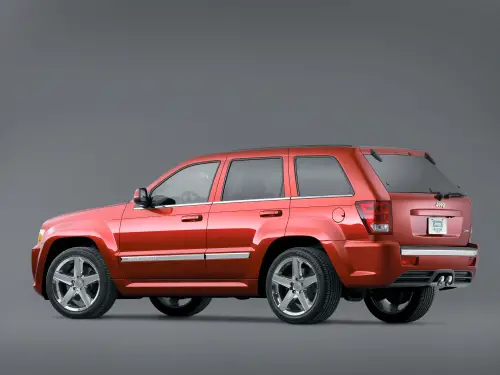 2007 Jeep Grand Cherokee SRT8 |
Jeep 2007 Grand Cherokee SRT8 Announcement
By Thom Cannell
Detroit Bureau
The Auto Channel
Executive Summary: One Week With 2007 Grand Cherokee SRT8
No attempt at completeness, simply comments on one week’s driving experience—balanced by decades of experience and hundreds of comparisons.
Jeep Grand Cherokee SRT8 is not a year old and already gaining some nifty enhancements to its premium street cred.
Launched last December as a stern competitor to super premium SUVs like Porsche Cayenne, BMW X5, Range Rover Sport, it offers more performance for less than half the price. What could be better?
Built by Chrysler Group’s Street and Race Technology group, this was the first Jeep tuned by SRT and the first SRT with full time all wheel drive. The SRT8 uses a one-of-a-kind transfer case combining a lightweight Jeep front half and a heavy-duty rear half that encloses its electronic AWD control system.
The Grand Cherokee SRT8 needs that AWD system, as under the hood is a 6.1-liter 420 horsepower Hemi V-8 that spins tires with 420 pound-feet of torque, accelerating to 60 in under 5 seconds, wet or dry.
You might wrongly suspect that a $39,300 (plus $695 destination) full-sized SUV might be short on luxury or amenities. While goodies like the DVD navigation system, new for 2007 rearview camera or remote start are options, the basic package delivers what a driver really wants. You get some of the best and most heavily bolstered performance seats this side of NASCAR, unique instrument panel with aluminum accents, and access to most engine functions (oil temperature and pressure, distance to empty, dual trip meters, that kind of stuff) on an LED display that normally displays compass heading and exterior temperature.
Outside there’s no missing changes to the chiseled Jeep Grand Cherokee body; twin center-mounted chrome rear exhausts, black mesh inserts in the grille, and a massive front air dam. Behind the spokes of 20” forged aluminum five spoke wheels are massive (360x32 mm front/350x28 rear) vented Brembo anti-lock brakes with glossy black caliper bodies. Given a choice I’d prefer more colorful red or yellow. Wrapped around those 9” wide wheels are W-rated runflat tires—255/45/20”-front, 285/40/20”-rear.
The SRT8 Grad Cherokee has other enhancements designed for a power and precision; upgraded 5-speed automatic transmission, Danna 44 rear differential, unique exhaust manifolds, modified steering, ducted brakes, and better cooling designed to make this a formidable machine. It also has several life-saving features like air bags and ESP or Electronic Stability system. Driving on frequently rain-slick two-lane roads covered in a summer’s oil, dirt, and trash with an admittedly heavy accelerator foot, I got used to ESP saving me from waving at my behind as it spun by. All that power and torque made it easy to accelerate at eyeball flattening rates and corner as aggressively as a vehicle weighing a ton (literally) less.
Naturally power, weight, and aggressive acceleration made for a thirsty 14 in-town miles-per-gallon, though that’s far better than the 12 MPG predicted.
Here’s the Executive Summary:
• Multiple rear tie-down points for various kinds of gear, plus hooks for grocery bags, webbed storage bin and a 12V power point.
• Carpeted 3”-deep rear flip-over wet storage bin big enough for four pairs of muddy boots or wet suits. Two additional hidden bins for items like a small handbag, digital cameras, or other medium sized gear.
• Second row seats fold flat easily with a single latch pull; seat headrests fold under automatically (no detaching and fumbling for storage.)
• Solid chiseled rugged exterior design with Jeep’s familiar 7-slot grille and massive round headlamps which I wish offered a brighter Xenon option. • Large and easily read instruments with brightly outlined speedometer and tachometer, additional gasoline and water temperature gauges, plus the multi-function display. But nowhere is there a voltage gauge.
• Center console contains two cup-holders and multiple bins for your phone, garage door opener, pencils, mini-tape recorder, candy bar—a bunch of them.
• Auto Stick driver-selectable shifter defaults to first gear on deceleration and will remain in a gear until shifted, even at the rev limit. It’s a good substitute for manual gears; I’d like a heavily overdriven 6th gear for better fuel mileage.
• Grand Cherokee SRT8 is easy to enter, it’s an inch lower than standard to lower aerodynamic drag and center of gravity.
• Steering is racecar tight and accurate and the springs and dampers are finely tuned to produce road-hugging performance without harshness. It is a firm and sophisticated ride created with SRT-tuned dampers, tailored spring rates and suspension bushings, and unique anti-roll bars.
• The performance of a 2007 Grand Cherokee SRT8 is awe inspiring with astonishing torque and horsepower on demand. Despite its weight of 4,819 pounds, instant power will nail you to the seat. Coupled with super car road manners, it is a multi-passenger vehicle to be reckoned with, one that can tow 3,500 pounds, carry five passengers and all of their luggage in comfort and modest luxury. Yes it will cost you more in gasoline than a regular Grand Cherokee, but that vehicle won’t leave a Porsche Cayenne Turbo in the dust.




 The biggest of the trio was the obvious starting point for this exercise, and according to Pete Gladysz, senior manager for SRT powertrains, adapting the GEMA engine for high output didn’t require any really dramatic departures from the stock engine’s basic components. There are new Mahle pistons, designed for a lower stock compression ratio (8.6:1 versus 10.5:1), forged steel connecting rods, valves designed for higher operating temps, heftier bottom-end bearings, oil squirters to keep the con rods and pistons cool, and an external oil cooler.
 The SRT4’s ECU, developed by Siemens, is a sophisticated piece of computer technology, and it governs boost and engine output over a broad range of operating parameters. But under ideal conditions, the turbo produces max boost of 16 psi, and with everything in optimum the new engine will churn 300 horsepower at 6000 rpm and 260 pound-feet of torque across an unusually broad range, from 2000 on to the horsepower peak. As with the previous SRT4, this adds up to a pretty seductive bang-for-buck story, only more so.
 All of this, according to the SRT guys, adds up to a 0-to-60 capability of less than six seconds, and we have no reason to doubt that. The question is how much less. The Caliber SRT4 is going to weigh in substantially heavier than the old SRT4 — at least 200 pounds — but even so, with all that torque and horsepower on tap, we expect numbers in the middle of the five-second scale. And the top end, according to Helbig, will be pretty high.
 All-wheel drive, an option in the regular Caliber lineup, would damp out torque steer, but the system isn’t capable of handling the turbo engine’s higher output. As you’d expect, the new hot rod’s underpinnings are upgraded to keep pace with the turbo motor’s big punch: heavier front knuckles, heavier hubs, beefier wheel bearings, higher spring rates, stiffer dampers, heavy-duty knuckles up front, heavier front and rear anti-roll bars, and a quicker ratio for the rack-and-pinion steering system.
 Which brings us back to the sequel issue. The SRT gang won’t say so, but the Caliber doesn’t look like a candidate for racing preparation. Although the static ride height is a half-inch lower than the standard Caliber’s, it still rides higher than the Neon. That, plus its high profile, adds up to a high center of gravity, and the higher curb weight doesn’t help, either. Looking at it from the street-machine perspective, there’s also a question, in our minds at least, whether the blocky styling is going to seduce the tuner crowd.


